
· by Michael Blair, Nashville's Windows & Doors
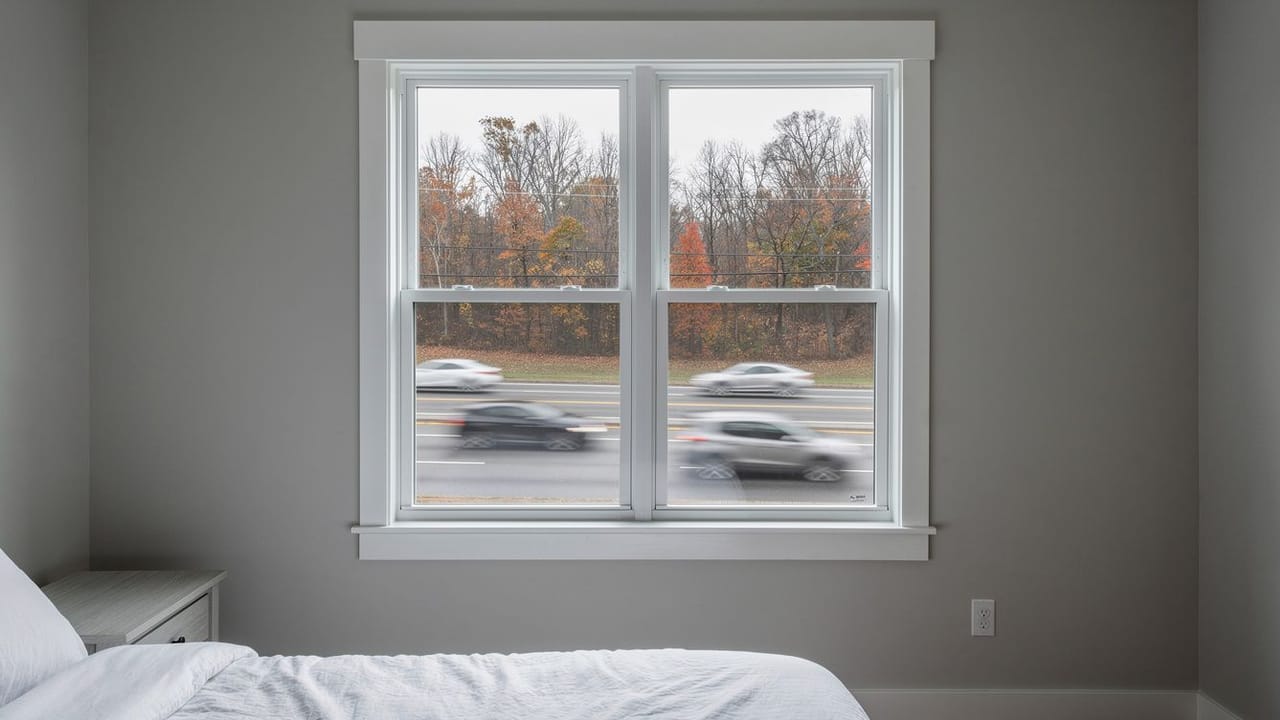
Road noise is one of the reasons people give us for replacing windows, and it is a fair one. The glass in a window is usually the thinnest part of the wall, so it is where traffic sound gets in first.
The trouble is that the window sold as the quiet one is not always the one that quiets a road. The rating on the label, the build of the glass and the way the unit is sealed into the opening each change what you hear in the bedroom at six in the morning. This post goes through what the glass makers’ own data shows.
Do new windows reduce road noise?
Yes, new windows can reduce road noise, and the build of the glass decides how much. The Guardian Glass guide to glass acoustic performance lists estimated ratings for common glass makeups. A standard double-pane unit of two 6 mm lites around a half-inch air space rates OITC 29 and STC 34. Swap the inner lite for a laminated one with an acoustic interlayer and the same unit rates OITC 35 and STC 41.
The guide also says that pairing lites of different thicknesses in one unit adds sound reduction, and that each 10 decibels is roughly a halving of how loud something sounds. A gain of six points is a change you can hear.
The surprise is the third pane. In the same table, a triple-pane unit of three 6 mm lites rates OITC 29, no better than the double-pane against traffic, though its STC rises to 37. If road noise is the reason for the order, a laminated lite earns its place before a third pane does.
Which rating should I read, STC or OITC?
For traffic, read OITC, the Outdoor-Indoor Transmission Class. Guardian describes OITC as the measure of how much glass cuts sounds such as road and rail traffic and nearby aircraft, and STC as the better fit for speech, which is why STC suits interior glass. It also warns that the two are not linearly related, so a strong STC does not promise a strong OITC.
STC is built around the sound of voices, and an engine on the road is a different sound. That is how a window can post a high STC number and still let a passing truck in. Eastman, which makes the Saflex interlayers used in laminated glass, notes in its explainer on acoustics and glass that OITC compresses the spread of results for glass, so real improvements can be hard to see in that number alone. Where noise is the whole point, it recommends looking at the full test data by frequency band.
Why does a quiet window still let noise in?
A window rated in a lab loses some of its rating once it is in a wall. Guardian says a gap of about 6 decibels between a laboratory test specimen and the same glass installed on site is possible, and that it amounts to losing about a third of the sound reduction you can perceive. Its table is also an estimate for the center of the glass, not a whole window with a frame and sash.
So we ask the maker for the tested rating of the complete unit, not the glass alone, and we treat the install as part of the sound job. Sound follows air, so the gap between the new frame and the old opening gets sealed fully and the sash has to close tight on its weatherstrip. That is the same detailing our trim and flashing work does to keep water out.
Where acoustic glass is worth it around Nashville
Acoustic glass is worth it in the rooms that face the noise, not in every window of the house. Around Nashville that usually means bedrooms on the side of the house toward an interstate, a state route or a road that has grown busy since the house was built. In Antioch, with I-24 running through, that conversation comes up often. The windows on the quiet side can stay standard double-pane.
If you are weighing whether replacing windows pays back at all, our post on when window replacement is worth it covers the reasons that hold up, and noise is one of them. For a road-facing room, tell us which rooms and what road, and we will price a standard unit and an acoustic laminated one side by side, each with its tested OITC.
Sources
- Guardian Glass, Expert Series: Glass Acoustic Performance — OITC and STC estimates by glass makeup, OITC for traffic noise, mixed lite thicknesses, the lab-to-site 6 dB loss.
- Eastman Saflex, Sounding off: what you need to know about acoustics and glass — How STC and OITC are derived, why OITC compresses results for glass, and reviewing band-by-band data.
FAQ
Windows That Cut Road Noise, and the Rating to Read — questions
Is laminated glass quieter than regular double pane?
In Guardian Glass’s laboratory estimates, yes. A double-pane unit of two 6 mm lites rates OITC 29, while the same unit with an acoustic laminated inner lite rates OITC 35. The plastic interlayer damps the glass, and that matters more for traffic than adding air spaces. Ask for the whole window’s tested rating.
Do triple pane windows block more traffic noise than double pane?
Not much, by the glass makers’ own numbers. Guardian’s table gives a triple-pane unit of three 6 mm lites an OITC of 29, the same as a standard double-pane, though its STC is higher. For road and rail noise, a laminated lite with an acoustic interlayer raises the OITC further than a third pane does.
Why is the STC rating higher than the OITC on the same window?
The two ratings weigh different sounds. STC is built around the pitch of human speech, and OITC around outdoor sources such as road and rail traffic and aircraft, so the same glass scores differently on each. Guardian notes the two are not linearly related, so a strong STC does not guarantee a strong OITC.
What OITC rating should a window have for a busy road?
There is no code minimum for a house, so compare the tested ratings of the units you are offered. In Guardian’s estimates, standard double-pane glass rates around 29 and double-pane with an acoustic laminated lite around 35. Guardian equates a rating of 30 with cutting perceived loudness to about an eighth.