
· by Michael Blair, Nashville's Windows & Doors
Most broken glass we see starts with something ordinary: a rock thrown by a string trimmer, a limb in a spring storm, a ball, a door that slammed in the wind. The first question is not the price of a pane but what actually has to be replaced, because on a modern window the glass is rarely a single sheet you can swap at the kitchen table. The second is whether the replacement has to be safety glass, which the code decides by where the window sits, not by what was there before. The third is what to do with the hole until the new glass arrives. Our glass and seal repair page covers the service itself; this is the reasoning behind it.
Glass, sash or the whole window
Almost every window built in the last few decades holds an insulating glass unit, which the NFRC Consumer Guide to Windows glossary defines as two or more pieces of glass spaced apart and hermetically sealed into one unit. A crack in one lite breaks that seal, so the repair is a whole new unit built to the size of the opening, not a single piece of glass. The U.S. Department of Energy’s Job Aid 22-1 on window glass replacement has the new pane cut 1/8 to 3/16 inch smaller than the opening, which is why we measure the glass itself and not just the frame. Older single-pane wood sash is different: there the glass is bedded in putty and one pane can be cut and reglazed on its own.
Whether the unit can come out of your sash by itself depends on how that window was built, and it is a question for the manufacturer or a glazier rather than a guess. The labels help. Marvin’s replacement parts page says its products made after November 2003 carry a laser-etched logo and identifiers in the glass corner of the sash or door panel, and older units have an engraving on the spacer bar. Most brands mark something similar, and a photo of it saves a trip.
A new sash makes sense when the sash frame itself is cracked, warped or soft, or when the glass cannot be released from it. The whole window is the better spend when the frame is rotted at the sill, the window will not stay up or lock, or it is one of several tired windows on the same wall, and our replacement windows page is the place to start in that case. If the glass is not broken but cloudy between the panes, that is a failed seal and a different problem, covered in why your double glazing has gone foggy.
Where the code calls for safety glass
Replacement glass in certain spots has to be safety glazing no matter what was in the opening before. Those spots are the hazardous locations in section R308.4 of the International Residential Code. The text below is from the 2018 IRC as adopted in Tennessee, Chapter 3. Metro Nashville now enforces the 2024 IRC under its adopted codes list, so confirm the section numbers against that edition before relying on them for a permit.
The window rule in R308.4.3 trips people up because all four of its conditions have to be true at once. A big picture window low to the floor beside a walkway qualifies, while a large window whose sill sits at normal height usually does not. The door and bathroom rules are simpler, and the DOE job aid says the same thing in plain terms: install tempered glass where the code requires it, and check that the replacement meets local code.
- R308.4.1: glass in swinging, sliding and bifold doors, fixed or operable panels alike, apart from openings too small for a 3-inch sphere and decorative glass
- R308.4.2: glass beside a door whose bottom edge is under 60 inches off the floor and within 24 inches of either side of the closed door
- R308.4.3: a window pane over 9 square feet, bottom edge under 18 inches and top edge over 36 inches above the floor, with a walking surface within 36 inches
- R308.4.5: glass by a tub, shower, spa or pool with its bottom edge under 60 inches above where you stand, unless it is more than 60 inches from the water or shower edge
- R308.4.6 and R308.4.7: glass under 36 inches above stairs, landings or ramps, and near the bottom landing within a 60-inch arc of the bottom tread
Tempered or laminated
Both are safety glass, and they fail in opposite ways. The NFRC glossary describes tempered glass as heated close to melting and cooled fast, so it breaks into small pieces, and it is the usual safety glazing in patio doors, entry doors and sidelights. Laminated glass is two or more sheets bonded to a plastic interlayer, so a broken pane stays attached to that layer. Cardinal Glass’s laminated safety glass page puts the contrast plainly: ordinary annealed glass breaks into large fragments that are a danger to anyone nearby, tempered breaks into small, benign pieces, and laminated stays in the frame.
That difference decides which one belongs in an opening. Vitro’s comparison of heat-strengthened and tempered glass notes that tempered glass is far more likely to fall out of the frame the moment it breaks, and that laminated should be considered where the glass needs to stay put. For most door glass and the glass beside a door, tempered is the standard answer. For a large low pane over a hard floor, a stair window or anywhere a falling sheet would land on someone, laminated is worth the extra lead time. Either way, R308.1 requires a permanent manufacturer’s mark on each safety pane naming the glass type and the standard it was tested to, and you should be able to find it in a corner of the new glass. Glass in a sliding door follows the same rules; our patio doors page covers the door side of that work.
Until the new glass arrives
Insulating units and tempered glass are made to order to the measured size, and tempered glass cannot be cut after it is tempered, so there is always a wait between the measurement and the install. In the meantime the job is to keep water, insects and anyone barefoot away from the opening. The Insurance Information Institute’s guide to settling claims asks homeowners to take reasonable steps to protect the property from further damage, photograph the damage and keep receipts, and it notes that payments for temporary repairs are part of the total settlement, so do the photos before you start covering anything.
If the house was built before 1978, the DOE job aid says to assume the window has lead paint, which matters as soon as anyone scrapes glazing putty or pries off stops. When you are ready, request a free estimate with a photo of the break and the corner of the glass, and we will tell you whether it is a glass, sash or window job before we come out.
- Wear gloves and eye protection, and lift out only shards that are already loose and could fall
- Run clear packing tape across a crack in a pane that is still whole so it does not spread
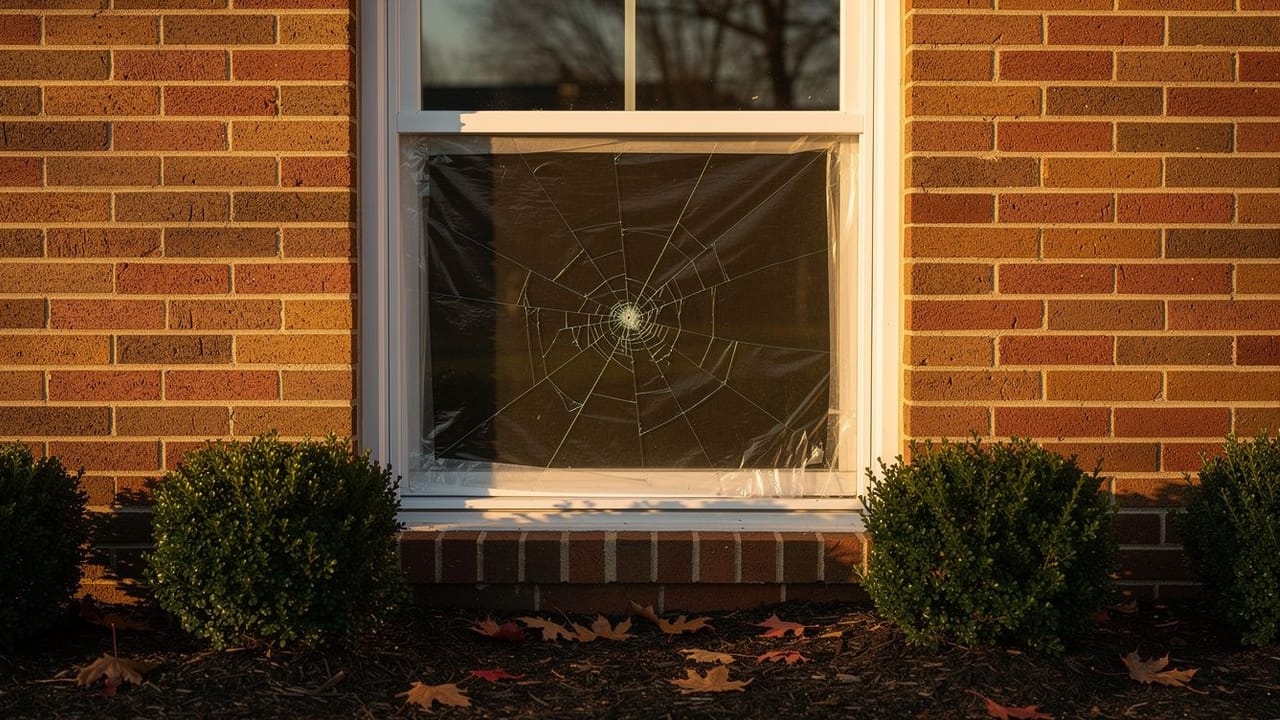
- Tape heavy plastic sheeting over the opening from outside, past the edges of the sash
- Sweep and vacuum the sill and the floor below, then keep children and pets out of that room
Sources
- Tennessee 2018 International Residential Code, Chapter 3, R308 (UpCodes) — Hazardous locations for glazing (R308.4.1 to R308.4.7) and the safety glazing mark (R308.1)
- Metro Nashville Codes Administration, adopted codes list — Metro Nashville enforces the 2024 IRC
- U.S. Department of Energy, Job Aid 22-1: Window Glass Replacement — Sizing the new pane, tempered glass where code requires, lead in pre-1978 windows
- NFRC Consumer Guide to Windows, glossary — Definitions of insulating glass, tempered glass and laminated glass
- Marvin, replacement parts — Where the product identifiers are on Marvin windows and doors
- Cardinal Glass Industries, laminated safety glass — How annealed, tempered and laminated glass break
- Vitro Glass Education, heat-strengthened vs tempered glass — Tempered glass falls from the frame on breakage; laminated stays anchored
- Insurance Information Institute, settling insurance claims after a disaster — Protect the property, photograph the damage, keep receipts for temporary repairs